
A Field Guide to Gel Ice Packs in Health & Medicine Cold Chain: Matching Models to Real Scenarios
A Field Guide to Gel Ice Packs in Health & Medicine Cold Chain: Matching Models to Real Scenarios
Gel ice packs are bought by the carton and then fail by the shipment. In health and medicine cold chain the failure is rarely a manufacturing defect — it is a mismatch between the pack and the payload it is supposed to protect. This field guide walks through how specific Jisi Cold Chain models map to real transport contexts: the BH004 and BH125 breast milk ice packs, the BH011 and BH014 mini ice packs, and the BH162 nylon PCM pack, alongside the wider range a buyer will meet during a tender.
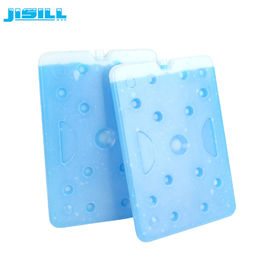
Large-format plastic gel ice packs such as the BH084 sit at the high-payload end of the range; model selection should follow payload volume and internal box dimensions, not habit.
Problem Definition: Why Gel Ice Pack Selection Goes Wrong
A gel ice pack is a passive component. It has no sensor, no alarm, and no way to compensate when the shipment it is packed with changes shape, mass, or ambient exposure. That makes the specification decision the only control point a procurement team actually has.
Three failure patterns repeat across health and medicine consignments:
- Thermal overshoot. A pack frozen far below the target band can chill a small payload below its acceptable range before the pack warms into its working zone.
- Insufficient mass. A thin pack chosen for a small carrier is then reused in a larger cool box, where the available cooling energy is spread across too much air volume.
- Clearance loss. A pack that is dimensionally correct on paper leaves no air gap around the payload, so the load cannot be arranged for even temperature distribution.
None of these are visible in a price-per-piece comparison. They only appear when the pack is matched against the actual payload, the actual container, and the actual duration of the journey — which is why a model-first selection process is more useful than a category-first one.
Industry Background: What Shapes the Choice in 2026
Health and medicine cold chain is a regulated transport environment, and the pack sits inside that regulation rather than outside it. The most useful reference point for buyers is the performance expectation applied to equipment: the WHO PQS verification protocol E004/CB01.3 requires medical-grade vaccine coolers to maintain 2–8°C for at least 48 hours under 43°C ambient temperature.
That benchmark matters because it sets the frame for how a gel ice pack, PCM ice pack, or eutectic cold plate is judged. The pack alone does not deliver a 48-hour hold; the combination of pack mass, container insulation, payload, and ambient profile does. A supplier can state a temperature grade, but the hold time belongs to the validated system.
Three structural factors shape model choice in practice:
- Temperature band.Jisi Cold Chain lists phase change material grades spanning -30°C, -25°C, -15°C, -10°C, -5°C, 0°C, 2–8°C, 18°C, and 23°C, so the range can be matched to refrigerated, frozen, and ambient-protected transport rather than forced into one band.
- Material and construction. Across the range the outer shell is commonly food-grade HDPE, with Cooling Gel, SAP, CMC, Cooling Powder, or PCM as the interior depending on model — a rigid HDPE shell resists compression in a packed box in a way a soft pack does not.
- Documentation. Listed certifications across the range include FDA, MSDS, CPSIA, SGS, LFGB, CE, and Regulation (EU) No. 10/2011, but they are attached per model, not per catalogue.
Changzhou Jisi Cold Chain Technology Co., Ltd. is a Chinese manufacturer established in 2013, operating from a 40,000 m² facility with approximately 60 employees, a four-engineer R&D team, and an annual output of 620,000 units. The company specialises in gel ice packs, PCM ice packs, cooler boxes, and VIP panels, exports around 70% of output, and serves North America, South America, Western Europe, Eastern Europe, Eastern Asia, and Southeast Asia. Its relevance here is structural: the range covers both the gel and phase change sides of the same decision, plus the insulated boxes the packs are specified into.
Detailed Solution: Matching Jisi Cold Chain Models to Real Scenarios
The practical way to select is to start from the shipment and work backwards to the model. The three scenario families below cover the majority of health and medicine requests, and each maps to a defined set of models.
1. Breast Milk and Maternal Transport: BH004 and BH125
The JISILL BH004 is a breast milk ice pack classified as a gel ice pack, intended for food keep fresh scenarios within the cold chain transportation industry, with overall dimensions of 21 × 10 × 5.2 cm and an applicable market of the EU. Its rectangular, upright format suits a milk storage bottle placed alongside it rather than on top of it.
The BH125 is the second breast milk ice pack model in the range. It is positioned in the same maternal and infant transport family as the BH004.
What this means for a buyer:
- Specify the container first. A breast milk ice pack works when the bottle, the pack, and the carrier gap are dimensioned together — 21 × 10 × 5.2 cm is a large face, and it needs a carrier that can take it flat.
- Confirm the temperature band explicitly. Breast milk transport is a chilled application, and the pack must be conditioned to the intended band before packing rather than taken straight from a deep freezer.
- Treat the two models as alternatives, not a hierarchy. Model choice follows carrier size and payload volume; where a specification is not published for a model, request it in writing rather than inferring it from a sibling model.
2. Compact Carriers and Small Payloads: BH011 and BH014 Mini Ice Packs
The JISI BH011 is a mini ice pack measuring 3.5 × 2.8 × 0.5 inches (approximately 10.8 × 5.8 × 2 cm) and weighing 100 g. It is BPA-free, non-toxic, and reusable. Its value is dimensional: at roughly 2 cm thick it takes up very little clearance in a compact carrier.
The BH014 is a mini ice pack that utilises phase change material technology and is designed for food keep fresh scenarios in the cold chain transportation industry, with an applicable market of the US and EU.
Where these models earn their place:
- Small-payload kits. Sample transport, small diagnostic kits, and short-duration hand-carried shipments where a 1,000 g ice brick would overwhelm the load.
- Multiple-point placement. Because each BH011 weighs 100 g, several units can be distributed around a payload instead of concentrating cooling on one face.
- Phase change control. The BH014 uses PCM rather than a conventional gel fill, which allows the pack to be selected against a target band instead of a single frozen state.
3. Cooler Bags and Cooler Boxes: BH162 Nylon PCM Pack
The JISILL BH162 is a portable, reusable nylon cooler PCM gel ice pack designed for food freshness in cold chain transportation. It is built with a Nylon PE outer layer and a PCM inner material, and is available in two configurations: 250 ml at 18.6 × 10.3 cm and 500 ml at 22.5 × 13.5 cm. Its listed certifications are SGS, FDA, MSDS, CPSIA, and LFGB, its colour can be customised, and its place of origin is China.
The nylon PE outer is the distinguishing detail. Where a rigid HDPE ice brick is built for stacking and compression, a flexible nylon pack conforms to the internal contour of a cool bag or cooler box, which reduces dead air space between the pack and the payload.
Selection notes for this model:
- The 250 ml size suits a soft cool bag or a single-payload carrier; the 500 ml size suits a cooler box where the larger surface area can act across a wider load.
- PCM interior means the pack is chosen against a phase change temperature, not against a generic freeze instruction — confirm the intended band before ordering.
- Colour customisation is available, which matters where packs are assigned to specific routes, departments, or clients and need visual identification.
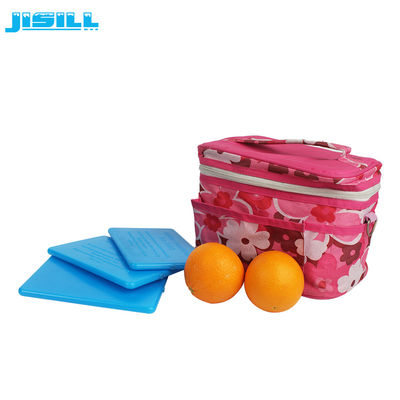
Ultra-thin formats such as the BH073 (18.5 × 17.5 × 1.2 cm, 260 ml) show how flat packs are specified when a carrier leaves little internal clearance.
Model Comparison Table
The table below uses only published specifications. Where a field is marked with a dash, the specification is not stated in the available product data and should be confirmed in writing with the supplier before a model is written into a specification.
| Model | Type | Outer / Interior | Size and Capacity | Weight | Listed Certifications | Typical Scenario |
|---|---|---|---|---|---|---|
| BH004 | Breast Milk Ice Pack (gel ice pack) | — | 21 × 10 × 5.2 cm | — | — | Breast milk and food keep fresh transport (EU market) |
| BH125 | Breast Milk Ice Pack | — | — | — | — | Maternal and infant chilled transport |
| BH011 | Mini Ice Pack | BPA-free, non-toxic, reusable | 3.5 × 2.8 × 0.5 in (approx. 10.8 × 5.8 × 2 cm) | 100 g | — | Compact carriers, small diagnostic kits |
| BH014 | Mini Ice Pack (PCM) | Phase change material | — | — | — | Food keep fresh, US/EU compact transport |
| BH162 | Cool Bag Ice Pack (PCM gel) | Nylon PE / PCM | 250 ml: 18.6 × 10.3 cm; 500 ml: 22.5 × 13.5 cm | — | SGS, FDA, MSDS, CPSIA, LFGB | Cool bags, cooler boxes, flexible packing |
| BH047 | Ice Cooler Brick | Food Grade HDPE / Cooling Gel | 23.5 × 19.5 × 3 cm | 1,000 g | FDA, MSDS, CPSIA, Regulation (EU) No. 10/2011 | High-mass food keep fresh transport (EU) |
| BH084 | Large Cooler Ice Pack | Plastic HDPE / Cooling Liquid | 33 × 22.5 × 2 cm | 1,000 g | FDA, SGS, MSDS, CPSIA, EU | Large cooler box loads; freezing points from 0–8°C to -25°C |
| BH091 | PCM Ice Cooler Brick | Environmental HDPE / SAP CMC | 38.5 × 20 × 2 cm | 1,200 g | FDA, SGS, MSDS, CPSIA, CE | Outdoor frozen use at -22°C |
Reading the table correctly: a dash is not a limitation of the product, it is a gap in the published data. In a regulated procurement, an unpublished specification should always be converted into a written question rather than an assumption carried into the tender document.
Step-by-Step Breakdown: A Six-Step Model-Matching Process
Use Cases: How the Same Range Serves Different Buyers
Breast milk transport for maternal health programmes
The BH004 and BH125 address a chilled, small-volume, high-sensitivity payload. The practical constraint is usually the carrier, not the pack: a 21 × 10 × 5.2 cm pack needs a carrier that accepts it flat against the bottle rather than compressing it. Where a programme distributes packs to multiple collection points, colour customisation and carton packing simplify onward distribution.
Food and specimen freshness in short-duration transfer
Food keep fresh is the stated application for the BH014, BH047, and BH162, and the same logic transfers to non-clinical specimen handling where a controlled chilled band is required. In these flows the pack is typically reused, so shell durability and a washable outer surface matter as much as thermal mass.
Cooler bag and cooler box logistics
Where the container is an insulated bag rather than a rigid box, the BH162's nylon PE construction is the relevant advantage. Where the container is a large rigid box, larger HDPE bricks such as the BH084 or the BH091 carry the required mass with less pack count.
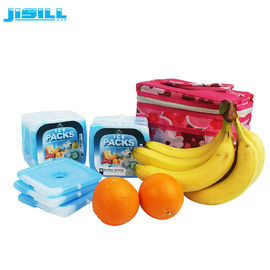
Compact rigid packs such as the BH025 (13.3 × 12.7 × 1.3 cm, 160 g) illustrate the small-footprint formats used in short-duration carry systems.
Vaccine and medical carrier systems
Gel ice packs are usually specified together with the insulated carrier. The Jisi JS-2.5L vaccine carrier is a portable cold chain cooler box with 6.5 L internal capacity, constructed from PU plus a vacuum insulation panel with thermal conductivity below 0.0025 W/m·K. When a pack and a carrier come from the same supplier, the interaction between pack format and internal geometry can be resolved in a single conversation rather than across two vendors.
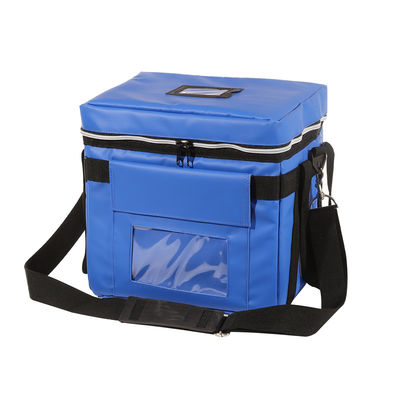
Insulated carriers and gel ice packs should be specified as one system; the JS-2.5L vaccine carrier combines PU with a vacuum insulation panel.
Samples, Bulk Delivery, Packaging, and Custom Colour
Once the model is chosen, the commercial terms follow a predictable pattern across the range.
- Samples. If you accept an existing model and do not require printing, free samples can be supplied, with freight paid by the buyer.
- Sample lead time. Typically within 2 days for standard models; up to 5 days where a cooler box configuration is involved.
- Bulk lead time. Commonly 7–10 days depending on order quantity; the BH162 is listed at 2 days after receiving full payment, and cooler box bulk orders at 10–15 days.
- MOQ. Usually 3,000 pieces for an existing model; above 5,000 pieces where a new model must be created.
- Packaging. Carton is the standard packing method, with other methods available on request. Examples: BH055 at 48 pcs per carton (40 × 27 × 17 cm), BH073 at 70 pcs per carton, BH066 at 75 pcs per carton, BH084 at 12 pcs per carton, and bh065 at 145 pcs per carton (65.5 × 47.5 × 31 cm).
- Customisation. Colour can be produced to a supplied sample or PANTONE code, subject to quantity. Silk screen printing, offset printing, or applied stickers are all available.
- Payment. T/T with 30% advance and 70% balance before delivery is standard; Western Union, PayPal, L/C, D/P, and D/A are also accepted.
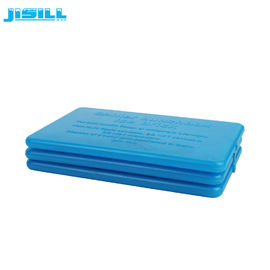
OEM formats such as the BH066 can be produced to a specified size; custom colours are available across the range.
Frequently Asked Questions
Which models carry FDA, CPSIA, and Regulation (EU) No. 10/2011 documentation?
Documentation is attached per model rather than to the catalogue as a whole. Published listings show the BH047 carrying FDA, MSDS, CPSIA, and Regulation (EU) No. 10/2011; the BH050 carrying FDA, MSDS, CPSIA, and Regulation (EU) No. 10/2011; the BH162 carrying SGS, FDA, MSDS, CPSIA, and LFGB; and the BH091 carrying FDA, SGS, MSDS, CPSIA, and CE. The BH004 breast milk ice pack is listed with an EU applicable market. Buyers should request the certificate documents for the exact model number and confirm the issuing body and scope before the model is written into a tender, because certificate coverage does not automatically transfer between models in the same family.
How long will a gel ice pack hold a 2–8°C payload?
Hold time is a property of the assembled system, not of the pack in isolation. It depends on pack mass, the number of packs, container insulation, payload mass, and ambient temperature. The WHO PQS protocol E004/CB01.3 sets the reference expectation for medical-grade vaccine coolers at 2–8°C for at least 48 hours under 43°C ambient. Jisi lists PCM grades that include a 2–8°C band, and freezing point options on models such as the BH084 spanning 0–8°C to -25°C, but a hold-time figure should be established by testing the actual pack-and-box configuration rather than extrapolated from a product page.
What is the minimum order quantity and how is pricing determined?
For an existing model the MOQ is usually 3,000 pieces. Where a new model must be created for the buyer, it is preferable to exceed 5,000 pieces. Unit pricing is not published and depends on model, capacity, shell material, custom colour or printing, and order quantity; a quotation should be requested against a defined model and a stated annual or per-shipment volume.
Can we obtain free samples before committing to a bulk order?
Free samples can be supplied where the buyer accepts an existing model and does not require printing; freight is paid by the buyer. Standard samples are typically ready within 2 days, with cooler box configurations taking up to 5 days. Sampling is the correct stage to test fit inside the actual carrier, because dimensional suitability cannot be judged reliably from a specification sheet alone.
How quickly can a bulk order be delivered, and how is it packed?
Bulk lead time is commonly 7–10 days depending on quantity; the BH162 is listed at 2 days after receiving full payment, and cooler box bulk orders at 10–15 days. Carton is the standard packaging method, with alternatives available on request, and carton quantities vary by model. To move from evaluation to a confirmed production slot, send the target model, required quantity, destination market, and any colour or printing requirement to ying@czjmjs.com.
Conclusion
In health and medicine cold chain, the useful question is not which gel ice pack is generally better, but which model fits a defined payload inside a defined container for a defined duration. The Jisi Cold Chain range answers that question at several levels: the BH004 and BH125 for breast milk and maternal chilled transport, the BH011 and BH014 for compact carriers and small payloads, the BH162 nylon PCM pack for cool bags and cooler boxes, and larger HDPE and PCM ice bricks where payload mass demands it.
The controlling discipline is documentation. Temperature band, dimensions, shell material, listed certifications, and delivery windows are all specified per model, and a procurement team that treats each of those as a written question rather than an assumption will avoid the three failures that dominate this category. Match the model to the scenario, then validate the system before scaling.
Need help matching a model to your shipment?
Send the payload weight, internal box dimensions, target temperature band, and required hold time. Jisi Cold Chain will confirm the closest model, sample availability, and a bulk delivery window.
Email ying@czjmjs.com · Phone / WeChat 13861230192 · cooler-icepacks.com
Full product and specification reference: Download the Jisi Cold Chain catalogue (PDF)
Have Questions or Need More Details?
Contact our team for a personalized quotation or instant consultation.
Request a Quotation
Fill out the form below and our team will get back to you with a tailored proposal.
WhatsApp Direct Chat
Prefer to chat in real-time? Message us on WhatsApp for instant assistance & quick answers.
- Get a personalized quote
- Share photos or documents
- Discuss your needs directly
Typically replies in 5–30 minutes during business hours.