
What's Inside a Cooling Gel Pack? The Anatomy of a Gel Ice Pack and Why It Stays Cold
A gel ice pack is a sealed plastic shell filled with either a water-based gel or a phase change material (PCM). The shell holds everything together; the core stores the cold. Gel ice packs work because their filler changes phase — from solid to liquid — instead of simply melting away, absorbing heat along the way. That one design decision is what lets a gel pack hold a flatter temperature curve, stay flexible when frozen, and keep working shipment after shipment.
For anyone shipping food, breast milk, samples, or temperature-sensitive medicine for the first time, 'what's inside' is not a trivia question. It decides how long a box stays cold, whether the contents arrive in usable condition, and whether the pack can be reused. This guide walks through a cooling gel pack layer by layer: the outer shell, the gel chemistry that holds water in place, and the PCM core used when a precise temperature has to be held.
Concrete product builds from Changzhou Jisi Cold Chain Technology Co., Ltd. (JISI) are used as illustrations throughout. JISI is a manufacturer of gel ice packs, PCM ice plates, cooler boxes, and vacuum insulation panels, operating a 40,000 m² facility in Changzhou, Jiangsu, China, with an annual output of approximately 620,000 units and around 70% of production exported to North America, South America, Western Europe, Eastern Europe, Eastern Asia, and Southeast Asia.
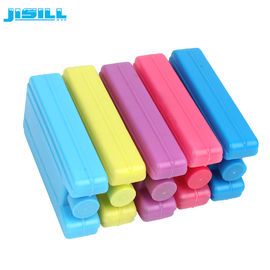
A standard gel ice pack: food-grade HDPE shell, SAP CMC gel core, reusable and non-toxic. Model BH011.
The Problem: Why Loose Ice Is a Poor Fit for Cold Chain Shipping
Loose or bagged ice is cheap, available, and almost always the wrong tool for a controlled cold chain. It has four practical problems.
- It becomes water. Ice melts into meltwater that soaks cartons, smears labels, and wets food-contact surfaces.
- It has no fixed shape. Cubes and crushed ice leave air pockets between the coolant and the payload, and air is a poor conductor of cold.
- It has no defined temperature. Ice sits at its own melting point. It cannot be tuned to a target window such as 2–8 °C.
- It cannot be reused. Every shipment needs a fresh batch, which makes cost and performance hard to standardise.
A gel ice pack addresses all four at once. The filler is sealed inside a shell, so nothing leaks into the box. The pack can be moulded into a flat plate, a slim brick, or a small square that fits a lunch bag. The gel is formulated to freeze and thaw over a chosen range. And the same pack can be refrozen and used again.
The catch is that 'gel ice pack' covers a wide range of constructions. Two packs of identical size can behave very differently depending on what the shell is made of and what is inside it. That is why the anatomy matters before you buy — and why this article treats the contents, not the label, as the starting point.
Industry Background: How Gel and PCM Packs Became Standard Cold Chain Equipment
Cold chain packaging grew into a substantial industry precisely because the contents it protects are unforgiving. Published research puts the global reusable ice pack market at roughly USD 1.962 billion in 2024, with projections of about USD 2.862 billion by 2035 (Market Research Future). The narrower PCM pack segment — driven by demand for precise thermal management in biologics — was valued at about USD 476 million in 2025 and is growing at a compound annual rate of roughly 4.5% (Intel Market Research).
The medical side of the market carries the strictest requirements. Vaccine storage equipment, including cold boxes and carriers, is projected to grow from about USD 0.86 billion in 2024 to about USD 1.21 billion by 2029 (MarketsandMarkets). The WHO PQS performance specification E004/VC01.2 sets out the standard for vaccine carriers and cold boxes and requires verified 'cold life' durations rather than laboratory claims — which is why manufacturers in this segment publish tested hold times instead of headline estimates.
Manufacturing is concentrated. As of 2025, China accounted for more than 11.2% of global gel ice pack revenues and functions as a primary export hub for North America and Europe (Dataintelo). JISI sits inside that supply base: the company's PCM ice plates are produced across a range of set temperatures — including −30 °C, −25 °C, −15 °C, −10 °C, −5 °C, 0 °C, 2–8 °C, 18 °C, and 23 °C — to cover the refrigerated transport needs of ice cream, food, vaccines, and pharmaceuticals.
The Anatomy of a Cooling Gel Pack
Strip away the branding and almost every gel ice pack is the same three-part system: an outer shell, a filler that stores cold, and a seal that keeps the two apart. The differences between models come down to what each layer is made of.

A rigid reusable freezer pack, 16.5 × 9 × 1.8 cm, 200 g, with an HDPE shell and SAP CMC gel core. Model BH055.
Layer 1 — The Outer Shell: Food-Grade HDPE (and Nylon PE)
The shell is the pack's structure, its moisture barrier, and its safety claim. In most rigid packs it is high-density polyethylene (HDPE): a tough, food-grade plastic that can be blow-moulded or injection-moulded into flat plates, slim bricks, or handled cooler blocks. HDPE takes impact without cracking, tolerates repeated freeze–thaw cycles, and does not react with the filler inside it.
Where flexibility matters more than rigidity, manufacturers switch to a laminated film such as nylon PE, which produces a thinner, softer pack that drapes around awkward shapes.
Two JISI builds show the difference. The BH004 breast milk ice pack, at 21 × 10 × 5.2 cm, uses a food-grade HDPE outer with a cooling gel core. The BH128 reusable pack, at 18 × 18 cm and 350 g, uses a food-grade nylon PE outer around a PCM core, which keeps the pack pliable for cooler bags and medical storage.
Layer 2 — The Gel Core: Water Held by SAP and CMC
The filler inside a standard gel pack is water — but water alone would slosh, freeze into a hard block, and escape as meltwater the moment the shell was compromised. Two additives change that.
- SAP (superabsorbent polymer) absorbs many times its own weight in water and locks it into a polymer network. The result is a gel that holds its shape, does not drain away, and stays semi-flexible even when frozen.
- CMC (carboxymethyl cellulose) is a cellulose-derived thickener that stabilises the gel and keeps water evenly distributed, so the pack freezes as one consistent mass rather than separating into ice and liquid.
Together, SAP and CMC turn ordinary water into a coolant that stays where it is put. Because the mixture remains pliable, the pack conforms to the surface of the payload instead of leaving gaps — and gaps are exactly where temperature creep starts.
The BH011 mini ice pack is a straightforward example: food-grade HDPE shell, SAP CMC gel inside, 100 g, BPA-free and non-toxic, designed for cooler bags, cooler boxes, and lunch bags. The BH014 mini pack, at 12 × 7.8 × 2 cm and 150 g, uses the same food-grade HDPE approach with a gel cooling liquid core and is available for OEM programmes.
Layer 3 — PCM: Cold Stored at a Set Temperature
A phase change material is engineered so that it changes from solid to liquid at one specific temperature. While that change is taking place, the material absorbs a large amount of heat without its own temperature rising. The payload sitting next to it therefore stays pinned close to that temperature plateau instead of drifting upward.
That is a different job from a standard gel pack. A gel pack is a general-purpose coolant; a PCM pack is a temperature-holding device. For a shipment of biologics, reagents, or vaccines that must stay inside a defined window, the plateau is the whole point.
JISI's PCM range illustrates the idea. The BH142 eutectic cold plate, at 24.5 × 24.5 × 2.5 cm and 1200 ml, uses a hard HDPE shell with an SAP/CMC/PCM core and carries SGS, FDA, MSDS, CPSIA, and LFGB documentation. The BH128 pairs a nylon PE shell with a PCM core for flexible applications.

A nylon PE outer paired with a PCM core: flexible construction for cooler bags and medical storage. Model BH128.
Seals, Closures, and Reusability
The final element is the least visible and the most likely to fail: the seal. A gel pack is only as good as the weld or cap that keeps the filler inside. Rigid HDPE packs are typically moulded as a single sealed unit or closed with a screw cap; film packs rely on a heat-welded edge. A reusable pack should be inspected for swelling, cracking, or a weeping seam before each freeze cycle, and retired when the shell is compromised — not after a shipment has already failed.
Why a Gel Pack Keeps Cold: The Simple Physics
Three properties explain how a gel ice pack behaves in a cooler box.
Heat capacity. Water absorbs a large amount of heat for every degree it warms. A water-based gel therefore acts as a thermal buffer: when surrounding air warms slightly, the pack absorbs that energy instead of passing it straight through to the payload.
Latent heat of phase change. When a frozen pack begins to thaw, it absorbs a large amount of energy while its own temperature barely moves. This is why a pack that is 'still partly frozen' can be doing more useful work than a smaller pack that is simply cold — the phase change is where most of the cooling capacity is stored.
Slowed melt, no drainage. In plain ice, the melted portion runs away and takes its cooling capacity with it. In a SAP/CMC gel, the water stays trapped in the polymer network, so the pack keeps its thermal mass in place and keeps performing at the point of contact.
The practical consequence: a gel pack holds a flatter temperature curve than loose ice, and a PCM pack flattens it further — but only within the band it was formulated for. A PCM plate rated for a medical window will not behave like a general-purpose freezer pack, and the reverse is equally true.
Step-by-Step: Getting the Most Out of a Gel Ice Pack
Gel ice packs are passive cooling devices. They do not generate cold; they store it and release it. That single fact shapes how they should be handled.
- Inspect before freezing. Check the shell and seal for cracks, swelling, or residue. A damaged pack should be retired immediately.
- Condition to the correct temperature. Standard gel packs need to be frozen solid. PCM packs need to reach their rated plateau, which may mean freezing fully and then allowing the material to settle to its phase change temperature if the application protocol requires it.
- Match the pack to the payload and the container. More thermal mass extends hold time, but oversized packs can over-chill sensitive contents. The right answer depends on the box and the duration of the trip.
- Always pair it with an insulated container or cooler bag. A gel pack on its own cannot hold a temperature. Insulated containers and cooler bags are the supporting equipment that makes the pack work; the combination — not the pack alone — determines cold life.
- Load and position deliberately. Minimise air gaps, distribute packs so cold reaches the whole payload, and use a liner where the protocol calls for one.
- Work with passive, on-demand operation. These systems use no power and no active refrigeration. Route planning and correct pack conditioning do the work.
- Dry and refreeze. After the shipment, dry the pack, inspect it again, and return it to the freezer so the next cycle starts from a fully conditioned state.
What the Certifications Actually Mean for Food-Contact Safety
Certification codes on a specification sheet are often listed without explanation. Here is what each one actually covers for a gel ice pack that will sit next to food, breast milk, or medical samples.
| Certification / standard | What it covers | Why it matters for a gel ice pack |
|---|---|---|
| FDA | US Food and Drug Administration requirements for materials in contact with food | Indicates the outer material and filler are treated as acceptable for food-contact use in the US market |
| SGS | Independent third-party testing and inspection | A report issued by an external laboratory rather than a manufacturer self-declaration |
| MSDS | Material Safety Data Sheet | Documents the composition, handling, and safety profile of the gel or PCM inside the pack |
| CPSIA | US Consumer Product Safety Improvement Act | Relevant when a pack may be handled by or near children, such as mini packs sold for lunch bags |
| CE | European conformity marking | Indicates the product meets the applicable EU requirements for the market it is placed in |
| Regulation (EU) No. 10/2011 | EU framework for plastic materials intended to come into contact with food | The specific EU rule governing a plastic ice pack shell used next to food |
| LFGB | German food and feed code | Commonly requested by European buyers as an additional food-contact reference |
For JISI packs, the outer material is HDPE and the inner liquid is SAP or CMC; the company states that all materials are non-toxic and food-grade, supported by FDA, SGS, and MSDS reports. Depending on the model, the documentation set also includes CPSIA, CE, LFGB, and Regulation (EU) No. 10/2011. Models cited in this article — BH004, BH011, BH014, BH055, BH128, and BH142 — appear on that list in different combinations, which is why a compliance file should reference the exact model number rather than the brand alone.
Certification also has a second function: it makes reuse defensible. A reusable pack that is food-grade, documented, and inspected between cycles can serve many shipments. A single-use pack with no documentation cannot make that claim — and neither can a reusable pack whose shell has started to weep.
Use Cases: Matching the Build to the Scenario
Because construction determines behaviour, the right pack depends on what is being shipped and where it is going.
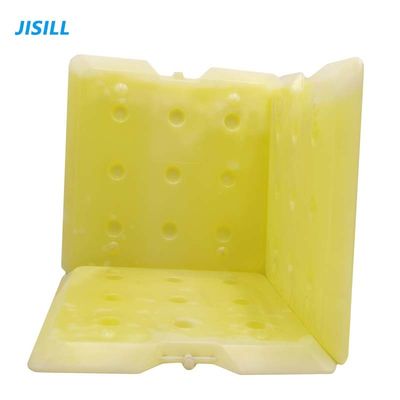
A PCM eutectic cold plate: hard HDPE shell, SAP/CMC/PCM core, 1200 ml. Model BH142.
Food keep-fresh and cooler bags
For groceries, meal kits, and cold drinks, the priority is thermal mass in a stackable format. The BH004 breast milk ice pack (21 × 10 × 5.2 cm, food-grade HDPE, cooling gel) suits breast milk and food keep-fresh applications. Slimmer formats such as the BH073 ultra thin pack (18.5 × 17.5 × 1.2 cm, 260 ml) and the BH066 thin chiller brick (19 × 12.5 × 1 cm) fit cooler bags and wine carriers where a rigid block would not.
Cooler bags, lunch bags, and small formats
For daily use, small and light wins. The BH011 mini ice pack at 100 g — BPA-free, non-toxic, SAP CMC gel — is built for exactly this, and its square format makes it easy to arrange around a lunch container. The BH014 mini pack (12 × 7.8 × 2 cm, 150 g) covers the same ground with OEM customisation available.
Cooler boxes and medical transport
When the requirement is a defined temperature over a longer trip, the pack is only half the system; insulated containers do the rest. The JISI JS-42L medical transport box has a 42 L internal capacity, PU plus vacuum insulation panel construction, and thermal conductivity below 0.0025 W/m·K, and is built for 2–8 °C vaccine and reagent transport. The BWX003 collapsible vacuum insulated box, at 74.7 L, is rated for 48–72 hours of cold time at 2–8 °C or −30–0 °C. In both cases the gel or PCM plate is the cold source, and the insulation panel is what converts that cold into hold time.
Scenario also matters on the receiving end. A logistics or pharmaceutical operation moving temperature-sensitive goods continuously will care about reusable formats, consistent plate dimensions, and a reliable refreeze cycle. That pattern sits behind a JISI case in which a US logistics and pharmaceutical transport customer has used PCM ice plates across a six-year programme totalling more than 1,000,000 units, reported to operate stably at low temperature.
OEM and promotional programmes
Where the pack is part of a brand's own product — a cooler bag sold with a branded ice pack, a promotional mini pack, a private-label lunch set — customisation becomes the deciding factor. JISI runs OEM and ODM production with customisation across shape, temperature, colour, size, and logo, colour matching to PANTONE codes or supplied samples, and 100% testing in quality control. Printing options include silk screen printing, offset printing, or an applied sticker.
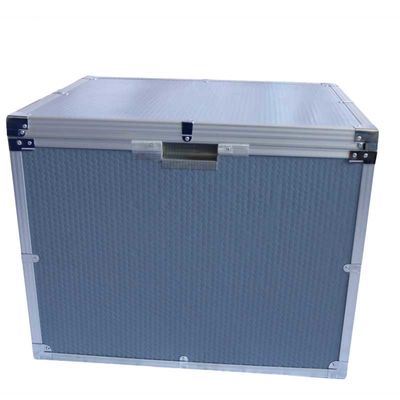
Gel and PCM plates supply the cold; the insulated box turns it into hold time. JS-42L medical transport box, 42 L.
Comparison Table: JISI Gel and PCM Ice Packs Side by Side
| Model | Format & size | Shell | Core | Typical scenario | Documentation |
|---|---|---|---|---|---|
| BH004 | 21 × 10 × 5.2 cm | Food-grade HDPE | Cooling gel | Breast milk and food keep-fresh | FDA, MSDS, CPSIA, Regulation (EU) No. 10/2011 |
| BH011 | 10.8 × 5.8 × 2 cm, 100 g | Food-grade HDPE | SAP CMC gel | Cooler bag, cooler box, lunch bag | FDA, SGS, MSDS, CPSIA, CE |
| BH014 | 12 × 7.8 × 2 cm, 150 g | Food-grade HDPE | Gel cooling liquid | Small-format and promotional packs, OEM | FDA, MSDS, CPSIA, Regulation (EU) No. 10/2011 |
| BH055 | 16.5 × 9 × 1.8 cm, 200 g | HDPE | SAP CMC gel | General reusable freezer pack | FDA, SGS, MSDS, CPSIA, CE |
| BH128 | 18 × 18 cm, 350 g | Food-grade nylon PE | PCM | Food keep-fresh, medical storage | FDA, MSDS, CPSIA, Regulation (EU) No. 10/2011 |
| BH142 | 24.5 × 24.5 × 2.5 cm, 1200 ml | Hard HDPE | SAP / CMC / PCM | Eutectic cold plate for larger loads | SGS, FDA, MSDS, CPSIA, LFGB |
Read the table by column, not by row. If the payload is food and the container is a cooler bag, the gel-core builds — BH004, BH011, BH014, BH055 — are the fit. If the payload has to hold a defined temperature for hours, the PCM builds — BH128 and BH142 — combined with an insulated container are the fit. Size scales with thermal mass: a 1200 ml cold plate stores more cold than a 100 g mini pack and should be specified accordingly, not substituted one for one.
Frequently Asked Questions
Are JISI gel ice packs safe to use next to food and breast milk?
The outer material of JISI gel ice packs is HDPE and the inner liquid is SAP or CMC. The company states that all of these materials are non-toxic and food-grade, supported by FDA, SGS, and MSDS reports. Depending on the model, documentation also includes CPSIA, CE, LFGB, and Regulation (EU) No. 10/2011. Because the documentation set differs by model, a compliance file should reference the exact model number — for example BH004 for a breast milk ice pack or BH011 for a mini pack — rather than the brand name alone.
Can gel ice packs be customised in shape, temperature, colour, and size?
JISI operates OEM and ODM production with customisation across shape, temperature, colour, size, and logo, and can match colours to a PANTONE code or to a supplied sample depending on order quantity. Models BH014 and BH128 both carry OEM capability in the range. Printing options include silk screen printing, offset printing, or an applied sticker, selected according to the artwork.
What is the minimum order quantity, and does customisation change it?
If an existing JISI model is acceptable and no printing is required, the minimum order quantity is usually 3,000 pieces. If a new model has to be created specifically for the buyer, the recommended quantity is more than 5,000 pieces. Colour customisation also depends on the order quantity.
Can I get samples before placing an order?
Yes. Where an existing model is used and no printing is required, JISI can supply free samples, with the freight paid by the buyer. Sample lead time for stock models is typically within 2 days.
What lead times should I expect for production?
For gel ice pack models, samples are typically available within 2 days and bulk orders ship in roughly 7–10 days depending on quantity; some models are quoted at 2–3 days. Larger insulated items follow a different schedule — the 42 L medical transport box is quoted at 10–15 days for bulk orders, and the BWX003 collapsible vacuum insulated box at 15 working days. Because lead time depends on both model and volume, the fastest way to get a firm date is to send your model list and quantities for a quote.
Conclusion: Read the Contents, Not the Label
A cooling gel pack is simple by design: a food-grade shell, a filler that stores cold, and a seal that keeps the two apart. What separates one pack from another is the choice made at each layer — HDPE or nylon PE outside, SAP/CMC gel or PCM inside, and documentation that covers the market the pack will ship into. A standard gel pack is a coolant; a PCM pack is a temperature-holding device. Both are passive, both need an insulated container or cooler bag to do their job, and both perform best when matched to the scenario rather than bought by size alone.
Next Step: Match the Pack to Your Scenario
If you are specifying gel ice packs for a cooler bag, a cooler box, or a medical transport programme, the fastest route is to compare real builds against your requirements — shell material, gel or PCM core, dimensions, thermal mass, and the certifications your destination market requires.
JISI Cold Chain supplies gel ice packs, PCM ice plates, cooler boxes, and vacuum insulation panels, and can quote against specific models or develop new ones. Request samples, a quotation, or the full catalogue at cooler-icepacks.com, or download the product brochure: JISI Cold Chain product brochure (PDF).
Contact: Ying — email ying@czjmjs.com, phone +86 13861230192. Factory address: No.9 Chuangye Road, Henglin Town, Changzhou City, Jiangsu Province, China.
Have Questions or Need More Details?
Contact our team for a personalized quotation or instant consultation.
Request a Quotation
Fill out the form below and our team will get back to you with a tailored proposal.
WhatsApp Direct Chat
Prefer to chat in real-time? Message us on WhatsApp for instant assistance & quick answers.
- Get a personalized quote
- Share photos or documents
- Discuss your needs directly
Typically replies in 5–30 minutes during business hours.