
Gel Ice Packs for Cold Chain Projects: A Buyer’s Scenario-Matching Guide
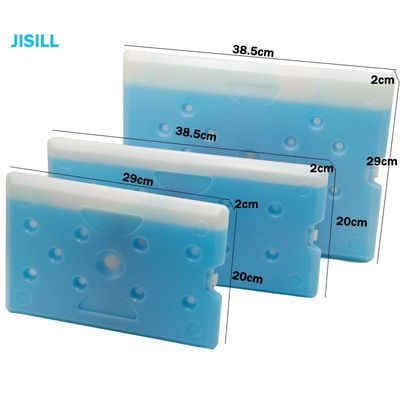
For procurement teams evaluating gel ice packs for a cold chain project, the core question is not 'which pack is cheapest' but 'which pack will hold the required temperature in the real operating environment.' A gel ice pack is a passive cooling component: it stores cold before use and releases it gradually during transport. It works through passive cooling and on-demand use operation, and it must be used with insulated containers or cooler bags to achieve a predictable result.
Problem Definition: Why Scenario Fit Matters More Than Pack Price
Most temperature excursions in cold chain projects can be traced to a mismatch between three variables: the target temperature, the duration of the shipment, and the insulation or container system. The same pack that keeps a lunch bag cool for six hours will not support a 48-hour vaccine shipment unless the enclosure and pack type are designed for that duty.
This is a project-adaptation problem, not a simple product-selection problem. Buyers need to translate a thermal specification into a pack configuration. A structured approach can reduce the risk of over-specification, under-specification, and avoidable freight or quality costs.
Industry Background: The Growing Role of Gel Ice Packs in Cold Chain
The commercial importance of this decision is visible in the market data. The global reusable icepacks market was valued at approximately USD 1.962 billion in 2024 and is projected to reach USD 2.862 billion by 2035, according to Market Research Future. The Business Research Company estimates the global gel ice pack market at USD 14.56 billion in 2025, in part because of pharmaceutical cold chain demand. Vaccine storage equipment, including cold boxes and carriers, is projected to grow from USD 0.86 billion in 2024 to USD 1.21 billion by 2029, according to MarketsandMarkets.
At the component level, the phase change material (PCM) pack market was valued at USD 476 million in 2025 and is growing at a CAGR of 4.5%, according to Intel Market Research, driven by demand for precise thermal management in biologics. China is a major production base, accounting for over 11.2% of global gel ice pack revenues as of 2025, according to Dataintelo. These figures point to a simple procurement reality: gel ice packs are not auxiliary accessories but engineered components in a temperature-controlled system.
For medical cold chain, WHO PQS performance specification E004/VC01.2 defines verified cold-life durations for vaccine carriers and cold boxes. This standard is a useful benchmark when evaluating an integrated system for vaccine distribution.
Detailed Solution: A Framework for Matching Gel Ice Packs to Project Requirements
One manufacturer with a relevant product matrix is Changzhou Jisi Cold Chain Technology Co., Ltd. (Jisi Cold Chain), a China-based factory specializing in PCM ice packs, cooler boxes, and vacuum insulated panels. Its product range includes hard plastic gel packs, PCM plates, and insulated medical boxes, which makes it a useful reference for scenario mapping.
1. Define the Temperature Window
The required temperature depends on the cargo. For vaccines and pharmaceuticals, 2–8°C is common; for frozen food and ice cream, -15°C to -25°C is typical. Jisi Cold Chain’s PCM ice plates are produced in several temperature variants: -30°C, -25°C, -15°C, -10°C, -5°C, 0°C, 2–8°C, 18°C, and 23°C. This range covers frozen food, vaccines, drugs, and temperature-controlled distribution.
2. Set the Cold-Life Target and Evaluate the Insulation System
A gel ice pack by itself does not create a cold chain. It works through passive cooling and on-demand use operation. It must be used with insulated containers or cooler bags. The combined performance of the pack and the enclosure determines how long the internal temperature can be maintained.
For example, Jisi Cold Chain’s cooler boxes use PU or VIP panels. With low thermal conductivity and PCM ice plates, the duration can last 12 hours, 24 hours, 48 hours, 72 hours, 96 hours, or even 120 hours. The selected cold-life target should be based on the longest lane in the network, not the average lane.
3. Select the Pack Format That Fits the Workflow
Product format should match the physical space in the container and the touchpoints of the workflow. Common options include:
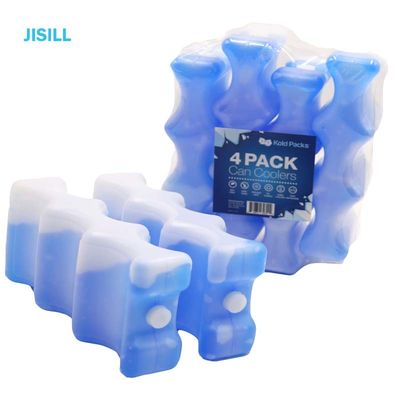
- Large Cooler Ice Packs / Ice Cooler Bricks — larger HDPE packs with cooling gel or PCM, for cool boxes and frozen transport. Model BH084 measures 33 × 22.5 × 2 cm and weighs 1,000 g, with freezing points from 0–8°C down to -10°C, -15°C, -18°C, -20°C, or -25°C.
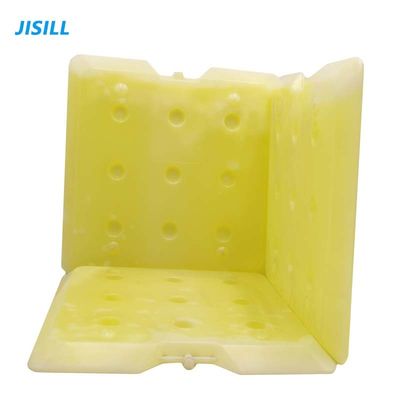
- PCM Ice Packs / Eutectic Cold Plates — hard plastic plates with phase change material, used when a specific temperature needs to be held for a longer period. Model BH142 measures 24.5 × 24.5 × 2.5 cm and holds 1,200 ml.
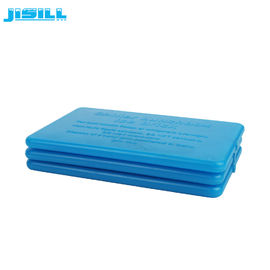
- Ultra Thin Ice Packs — slim packs for lunch bags, cooler bags, and wine coolers. Model BH073 is 18.5 × 17.5 × 1.2 cm with a 260 ml capacity.
- Fan Ice Packs — shaped packs for ice cream carts and drink cooling. Model BH050 has a 350 ml capacity.
- Mini Ice Packs — small promotional or lunch-pack formats. Model BH014 measures 12 × 7.8 × 2 cm and weighs 150 g.
- Breast Milk Ice Packs — compact food-grade HDPE packs such as BH004 with a 21 × 10 × 5.2 cm size.
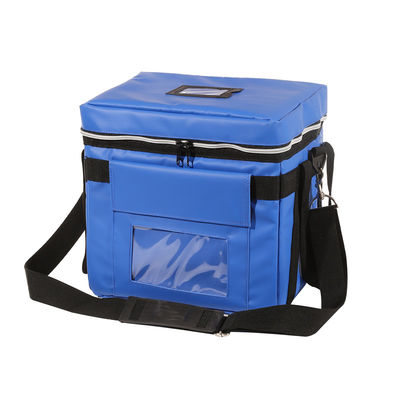
- Medical Cool Box and Vaccine Carriers — integrated insulated systems. The JS-42L medical transport box has an external size of 46 × 46 × 46 cm, an internal size of 35 × 35 × 35 cm, and a 42 L capacity, with PU plus vacuum insulation panels and thermal conductivity below 0.0025 W/m·K.
4. Verify Material and Compliance
Material choice is critical for food and health applications. Many Jisi ice packs use food-grade HDPE as the outer material and SAP/CMC/PCM as the inner material. The company states that all materials are non-toxic and that products carry FDA, SGS, and MSDS reports; some also list CPSIA and EU Regulation No. 102011. For medical use, this documentation should be checked against the destination market requirements.
5. Integrate the Pack with the Shipping System
The type of insulated container affects pack selection. A thin pack can be placed around a lunch box; a large brick or PCM plate is better for a 42 L medical cool box; a vacuum insulated panel system is used when cold life needs to be extended to 40 hours or more at -20°C. In all cases, the pack must be compatible with the enclosure design.
Step-by-Step Breakdown: How to Adapt Gel Ice Pack Selection to a Project
Step 1: Define the Target Temperature Range
Write the required product temperature, not just the ambient route temperature. If the cargo must remain at 2–8°C, a pack conditioned to a much lower temperature may cause freezing damage. If the cargo is ice cream, a 0°C pack will be insufficient.
Step 2: Set the Minimum Cold-Life Duration
Calculate from the longest expected transit time, including loading, waiting, and delivery buffer. For longer durations, choose a PCM plate or an integrated VIP cooler box rather than adding more standard gel packs.
Step 3: Choose the Pack Format and Placement
Map the internal dimensions of the insulated container. For even coverage, use flat rectangular packs. For tight side spaces, use slim or mini packs. For heavy frozen loads, use large bricks with a lower freezing point.
Step 4: Check Material, Certification, and Packaging
Confirm the outer material, inner liquid, and available certifications. Standard packing is carton; silk-screen printing, offset printing, or stickers can be added according to the buyer’s design.
Step 5: Request Samples and Run a Pilot
Samples are a practical way to validate performance before volume commitment. For existing models without custom printing, Jisi Cold Chain can supply free samples with freight paid by the buyer. Sample time for many standard packs is within 2 days.
Step 6: Validate Supplier Capacity and Lead Time
Capacity and lead time consistency matter for project planning. Jisi Cold Chain operates a 40,000 m² facility with an annual output of around 620,000 units and an export ratio of about 70%. For standard models, bulk orders are often delivered in 7–10 days; integrated medical boxes may take 10–15 days. The company supports OEM/ODM with customization of shape, temperature, color, size, and logo, and its quality control process includes 100% testing.
Use Cases: Project Scenarios and Recommended Configurations
Vaccine and Pharmaceutical Distribution
For temperature-sensitive medical products, a 2–8°C vaccine cooler box such as the JS-42L is a common configuration. It combines PU plus vacuum insulation panels with PCM plates. Thermal conductivity is below 0.0025 W/m·K. Buyers should also review WHO PQS E004/VC01.2 when defining acceptance criteria.
Frozen Food and Ice Cream
Frozen products require lower freezing points. Large cooler ice packs such as BH084 are available with freezing points at -10°C, -15°C, -18°C, -20°C, or -25°C. For stronger PCM performance, the custom PCM ice cooler brick BH091 is designed for -22°C frozen applications and measures 38.5 × 20 × 2 cm with a 1,200 g weight.
Last-Mile Meal and Lunch Kits
Ultra thin ice packs and lunch ice packs are used for cooler bags, lunch boxes, and bottle carriers. Model BH066 measures 19 × 12.5 × 1 cm, while the 130 ml lunch box ice pack BH024 has a slim 12.2 × 12.2 × 1.2 cm footprint. These formats fit into tight spaces around food containers.
Breast Milk and Personal Health
Compact packs such as BH004 use food-grade HDPE and cooling gel. The BPA-free, non-toxic BH125 is available in blue, pink, purple, white, red, or custom colors, which makes it suitable for consumer health and baby-care applications.
Long-Haul Medical Logistics Partnership
A long-running example from Jisi Cold Chain’s case history involves a logistics and pharmaceutical transportation client in the United States that has purchased 1,000,000 pieces over six years. The documented result is stable operation, which indicates the importance of consistent supply, repeatable quality, and reliable thermal performance in high-volume cold chain logistics.
Comparison Table: Standard Gel Packs vs. PCM Ice Plates vs. VIP Insulated Boxes
| Attribute | Standard Gel Ice Packs | PCM Ice Plates / Eutectic Cold Plates | VIP / PU Insulated Box System |
|---|---|---|---|
| Primary Role | Short-to-medium cooling in coolers and bags | Precise temperature holding for longer periods | Integrated insulated enclosure for medical or frozen transport |
| Typical Temperature Range | Freezing points from 0–8°C down to -25°C | PCM variants from -30°C to 23°C | 2–8°C medical box; -20°C box with 40 hours cold life |
| Inner Material | SAP/CMC cooling gel | SAP/CMC/PCM phase change material | VIP + PU foam, optionally with PCM plates |
| Container Requirement | Must be used with insulated containers or cooler bags | Must be used with insulated containers or cooler bags | Integrated container system; pack loading still matters |
| Example Model | BH084: 33 × 22.5 × 2 cm, 1,000 g | BH142: 24.5 × 24.5 × 2.5 cm, 1,200 ml | JS-42L: 42 L; BWX42L: -20°C, 40 hours |
| Certifications | FDA, SGS, MSDS, CPSIA, EU | FDA, SGS, MSDS, CPSIA, LFGB | FDA, MSDS, CPSIA; SGS for selected models |
Frequently Asked Questions
Are gel ice packs safe for food and medical cold chain use?
Jisi Cold Chain uses food-grade HDPE for the outer material and SAP/CMC or PCM for the inner material. The company states that all materials are non-toxic and that FDA, SGS, and MSDS reports are available; many packs also list CPSIA and EU Regulation No. 102011. Buyers should verify that the documentation matches the destination market requirements.
What temperature ranges can gel ice packs and PCM plates support?
Large cooler ice packs such as BH084 offer freezing points from 0–8°C down to -10°C, -15°C, -18°C, -20°C, or -25°C. PCM ice plates are produced with temperature variants of -30°C, -25°C, -15°C, -10°C, -5°C, 0°C, 2–8°C, 18°C, and 23°C. This allows a buyer to match the pack temperature to the cargo requirement.
What MOQ and lead time are typical for an OEM/ODM order?
Jisi Cold Chain supports OEM/ODM with customization of shape, temperature, color, size, and logo. For standard catalogue models, MOQ is often 3,000 pieces; for a newly created model, 5,000 pieces or more is preferred. Sample time is often within 2 days, and bulk delivery is typically 7–10 days depending on order quantity; integrated medical boxes may take 10–15 days.
Can I request samples before committing to a bulk order?
Yes. For existing models without custom printing, free samples are available, with freight paid by the buyer. This is a practical way to validate pack size, temperature performance, and fit inside your insulated container before full procurement.
How long can a cooler box system maintain temperature with gel ice packs or PCM plates?
The duration depends on the pack, the insulation, the ambient temperature, and the payload. Jisi Cold Chain states that with PU or VIP panels and PCM ice plates, duration can reach 12h, 24h, 48h, 72h, 96h, or even 120h. Specific models include a -20°C thermal insulation panel box with 42 L capacity and 40 hours cold life, and a collapsible VIP cooler box with 48 or 72 hours cold life.
Conclusion: Build the Specification Before You Choose the Pack
Selecting gel ice packs for a cold chain project is a scenario-adaptation task. A practical path is to define the temperature window, set the cold-life target, choose the pack format that fits the container, verify material compliance, and confirm supply lead time before volume commitment. The right answer for one project may be a thin lunch pack; for another, a 1,200 ml PCM plate; for another, an integrated 42 L medical cool box.
For teams moving from research to evaluation, Jisi Cold Chain offers a documented product matrix: food-grade HDPE packs, PCM plates, VIP-insulated boxes, OEM/ODM customization, and export experience across North America, South America, Western Europe, Eastern Europe, East Asia, and Southeast Asia. Requesting samples is the next practical step to test the pack in your own container and lane.
Next step: Match a gel ice pack to a specific cold chain project. Visit Jisi Cold Chain or download the company brochure for product specifications and contact options.
Email: ying@czjmjs.com | Phone/WhatsApp: +86 138 6123 0192
Have Questions or Need More Details?
Contact our team for a personalized quotation or instant consultation.
Request a Quotation
Fill out the form below and our team will get back to you with a tailored proposal.
WhatsApp Direct Chat
Prefer to chat in real-time? Message us on WhatsApp for instant assistance & quick answers.
- Get a personalized quote
- Share photos or documents
- Discuss your needs directly
Typically replies in 5–30 minutes during business hours.