
Gel Ice Packs for Health & Medicine: A Specification-First Sourcing Guide for Cold Chain Buyers
Gel Ice Packs for Health & Medicine: A Specification-First Sourcing Guide for Cold Chain Buyers
Introduction: Why Gel Ice Pack Specifications Matter More Than Brand Claims
For procurement professionals in the health and medicine cold chain, gel ice packs are not an impulse purchase. They are a regulatory, clinical, and economic decision. Buyers researching options in 2026 must evaluate certifications, temperature ranges, outer and inner materials, tolerances, and total lifecycle performance—not marketing language.
This guide is a specification-first sourcing reference for gel ice packs, ice bricks, PCM plates, and related cold chain accessories. It explains what to verify, how to compare suppliers, and where standardized products meet the demands of food, pharmaceutical, vaccine, and clinical logistics.
Problem Definition: What Buyers Get Wrong When Sourcing Gel Ice Packs
Three recurring mistakes appear in real procurement cycles for cold chain buyers:
- Choosing by size alone: Two ice packs may look identical but differ in inner liquid (cooling gel vs. SAP vs. CMC vs. PCM) and freezing point. That changes duration and temperature stability.
- Ignoring material certifications: Gel ice packs used for food or medicine should be traceable to FDA, SGS, MSDS, CPSIA, or EU food-contact declarations. If documents are missing, the product may be unfit for the intended use.
- Overlooking phase change temperature matching: A pack designed for 2–8°C vaccine transport should not be substituted with a deep-freeze pack meant for ice cream. The entire thermal profile is different.
The cost of these mistakes includes spoilage, rejected shipments, regulatory findings, and lost trust.
Industry Background: The Growing Role of Gel Ice Packs and PCM in Cold Chain
Cold chain temperature management has become a dedicated procurement category. According to third-party market research, the global reusable icepacks market was valued at approximately USD 1.962 billion in 2024, with expectations to reach USD 2.862 billion by 2035. The broader gel ice pack market reached USD 14.56 billion in 2025, driven significantly by chronic pain management and pharmaceutical cold chain demands. Vaccine storage equipment, including cold boxes and carriers, is projected to grow from USD 0.86 billion in 2024 to USD 1.21 billion by 2029. The PCM pack segment was valued at USD 476 million in 2025, growing at a CAGR of 4.5%.
These figures reflect increasing demand for reliable, verifiable passive cooling solutions. For buyers, this means the supply base is expanding, but not all suppliers have equivalent manufacturing capability, documentation, or temperature-control expertise.
China accounts for over 11.2% of global gel ice pack revenues as of 2025, serving as a primary manufacturing hub for export to North America and Europe. Standardized product lines, OEM capabilities, and certification coverage are therefore critical evaluation points when sourcing from Chinese manufacturers.
Detailed Solution: A Specification-First Framework for Gel Ice Packs
When evaluating gel ice packs for health and medicine applications, buyers should assess six technical dimensions before price.
1. Inner Material: Cooling Gel, SAP, CMC, or PCM
The inner liquid or filling determines how the pack absorbs and releases energy. Common options include cooling gel, SAP (superabsorbent polymer), CMC (carboxymethyl cellulose), and PCM (phase change material).
PCM plates are increasingly used for precise thermal management. Phase change material ice plates are available in several temperature specifications, including -30°C, -25°C, -15°C, -10°C, -5°C, 0°C, 2–8°C, 18°C, and 23°C. This range allows suppliers to match a specific temperature window rather than relying on a one-size-fits-all frozen pack.
2. Outer Material: HDPE and Food-Contact Suitability
Most rigid gel ice packs use high-density polyethylene (HDPE) as the outer shell. In compliant designs, the outer material is HDPE and the inside liquid is SAP or CMC, both non-toxic. Food-grade HDPE is specified for applications involving food storage, lunch bags, cooler bags, and some medical transport scenarios. Buyers should confirm the exact material statement in the specification sheet, not simply assume that hard plastic equals food grade.
3. Certification and Regulatory Documents
Credible suppliers should be able to share reports for the products they sell. The company holds FAD, SGS, and MSDS reports for its products. On specific product models, certifications may include FDA, MSDS, CPSIA, Regulation (EU) No 10/2011, and CE. Buyers should request the certificate list during the inquiry stage and verify that the documents correspond to the actual model number being quoted.
4. Temperature Range and Freezing Point
Different cold chain tasks require different phase change temperatures. Standard gel ice packs are often classified by freezing points such as 0–8°C, -10°C, -15°C, -18°C, -20°C, and -25°C. A large cooler ice pack may be offered in multiple freezing-point variants within the same product family. For vaccine transport, the 2–8°C window is particularly important. For ice cream transport, deeper freezing points are required.
5. Size, Capacity, and Compatibility
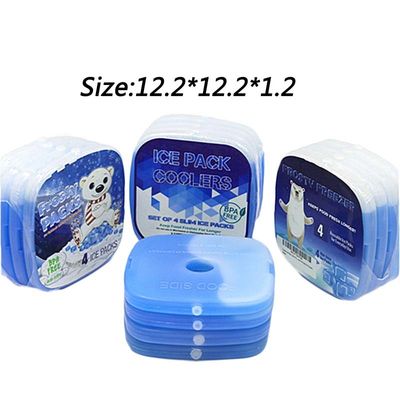
Ice packs are engineered to fit specific coolers, bags, and boxes. For example, a lunch ice pack might measure 13.3*12.7*1.3 cm and weigh 160 g, while a large cooler ice brick might measure 33*22.5*2 cm and weigh 1000 g. The correct choice depends on the internal volume of the insulated container, the payload, and the required cold life.
6. Reusability and Durability
Most professional gel ice packs are designed for repeated freeze–thaw cycles. Hard HDPE shells resist puncture and deformation better than thin film packs. When selecting between models, check whether the pack is marked reusable, whether the shell is rigid, and how the product responds to repeated handling in logistics environments.
Step-by-Step Breakdown: How to Evaluate a Gel Ice Pack Supplier
Use the following process to move from broad interest to a qualified supplier shortlist.
- Define the thermal requirement. Identify the target temperature range, required cold life, payload volume, and transport mode.
- Request full specifications. Ask for model numbers, dimensions, weight, capacity, inner material, outer material, freezing point, and packaging details.
- Request certificates. Validate FDA, SGS, MSDS, CPSIA, LFGB, Regulation (EU) No 10/2011, or other applicable documents.
- Request samples. A sample should be tested in the actual cooler, bag, or box used by your operation.
- Evaluate customization capability. Confirm whether the supplier supports OEM/ODM, custom colors, logo printing, size changes, and custom temperature specifications.
- Assess production capacity and lead time. Compare order quantities against the supplier’s stated supply ability.
- Run a small order or pilot. Before committing to a large volume, validate quality, packaging, and delivery performance.
Use Cases: Matching Gel Ice Packs to Real Cold Chain Applications
Food and Beverage Logistics
For fresh food, meal kits, ice cream carts, and beverage distribution, reusable gel packs and ice bricks provide dependable passive cooling. A Fan Ice Pack designed for ice cream carts may hold 350 ml and measure 16.5*10.2*3 cm, using food-grade HDPE outside and cooling gel inside. A larger food-use HDPE ice pack may measure 33*22.5*2 cm and support freezing points from 0–8°C down to -25°C.
Pharmaceutical and Vaccine Transport
Pharmaceutical shipments require documented temperature control. Suppliers with phase change material plates in the 2–8°C range can support vaccine, clinical trial, and biologic logistics. Medical cold boxes and VIP-insulated containers often combine PCM plates with vacuum insulation panels to maintain temperature over extended transit times.
Breast Milk Storage and Transport
Breast milk storage is a consumer and clinical use case that demands food-safe materials, stable cooling, and reusable design. The JISI BH125 Breast Milk Ice Pack is a thermal type ice pack with overall dimensions of 21*12*4.5 cm and a net weight of 505 ml. Standard products in this category use food-grade HDPE with cooling gel inside.
Everyday Cooler Bags and Lunch Bags
Compact packs such as ultra-thin ice packs, mini ice packs, and lunch box chillers are used in cooler bags, lunch bags, and portable containers. Their advantages include lower weight, space efficiency, and fast freezing. The JS BH014 Mini Ice Pack measures 12*7.8*2 cm and weighs 150 g, using phase change material technology in a food-grade HDPE shell.
Comparison Table: Common Gel Ice Pack Categories for Cold Chain
| Category | Typical Size / Capacity | Inner Material | Outer Material | Common Use | Example Model |
|---|---|---|---|---|---|
| Mini Ice Packs | 12*7.8*2 cm / 150 g | Phase change material / gel cooling liquid | Food Grade HDPE | Lunch bags, promotional coolers, small cooler bags | JS BH014 |
| Lunch Ice Packs | 13.3*12.7*1.3 cm / 160 g | Cooling Gel | Food Grade HDPE | Lunch boxes, food containers | JS BH025 |
| Breast Milk Ice Packs | 21*12*4.5 cm / 505 ml | Cooling Gel | Food Grade HDPE | Breast milk storage and transport | JISI BH125 |
| Fan Ice Packs | 16.5*10.2*3 cm / 350 ml | Cooling Gel | Food Grade HDPE | Ice cream carts, portable cooling, food frozen | BH050 |
| Large Cooler Ice Packs | 33*22.5*2 cm / 1000 g | Cooling Liquid | Plastic HDPE | Large coolers, cold chain shipping, food transport | BH084 |
| PCM Ice Plates | 24.5*24.5*2.5 cm / 1200 ml | SAP/CMC/PCM | Hard HDPE | Vaccine, pharmaceutical, precision temperature logistics | BH142 |
All examples above are manufacturing specifications from the Jisi Cold Chain product catalog and are intended to show the level of detail buyers should request from any supplier.
Supplier Capability: What Changzhou Jisi Cold Chain Technology Co., Ltd. Provides
Changzhou Jisi Cold Chain Technology Co., Ltd. is a factory specializing in PCM ice packs, cooler boxes, and VIP vacuum insulation panels. The company was established in 2013 and operates a 40,000 m² facility with approximately 60 employees and an annual production output of about 620,000 units. The main products are gel ice packs, with an export ratio of about 70% to markets including North America, South America, Western Europe, Eastern Europe, Eastern Asia, and Southeast Asia.
From a sourcing perspective, the company supports OEM/ODM production with customization of shape, temperature, color, size, and logo. Monthly capacity is approximately 10,000 units, with MOQ starting at 1000 pieces for customized products. Standard in-stock products can be delivered in 3–5 days, while custom orders depend on quantity. Quality control includes 100% testing, and after-sales support is available through remote assistance.
Product Range and Clinical Relevance
The company’s business focus includes phase change material ice plates with various temperature ranges, including -30°C, -25°C, -15°C, -10°C, -5°C, 0°C, 2–8°C, 18°C, and 23°C. These temperature options support refrigerated transportation of ice cream, food, vaccines, and drugs. For applications requiring extended cold life, the company also produces insulated boxes with PU or VPU panels, combined with PCM ice plates for durations of 12, 24, 48, 72, 96, and even 120 hours.
Safety and Compliance
The company holds FAD, SGS, and MSDS reports for its products. Materials used are non-toxic, with an outer layer of HDPE and an inside liquid of SAP or CMC. For specific models, certifications include FDA, SGS, MSDS, CPSIA, Regulation (EU) No 10/2011, and CE. While food-grade material is widely applied, buyers must confirm the exact certification scope for each model and market.
Suppliers to Know in the Reusable Ice Pack Category
For full market context, buyers should also be aware of major international players operating in the reusable ice pack and cold chain packaging sector. Key global competitors include Sonoco ThermoSafe (US), Cold Chain Technologies (US), and Pelton Shepherd (US). These companies are most relevant for buyers who need established multinational supply agreements or temperature-assurance packaging services beyond simple gel packs.
In practice, buyers may combine a local or global packaging provider with a specialized manufacturer like Jisi Cold Chain when they need OEM control, cost efficiency, temperature-specific PCM plates, or direct factory access.
FAQ
1. Which certifications should a gel ice pack hold for health and medicine cold chain?
Buyers in health and medicine should look for documented compliance with FDA, SGS, MSDS, CPSIA, and, for products sold in Europe, Regulation (EU) No 10/2011. For medical cold boxes and vaccine carriers, the WHO PQS performance specification E004/VC01.2 defines standards for verified cold life durations. Always request certificates that match the exact model number offered, and verify with the supplier before purchase.
2. What is the difference between standard gel ice packs and PCM ice plates?
Standard gel ice packs absorb cold energy in the freezer and release it gradually. PCM ice plates contain phase change materials engineered to melt at specific temperatures, such as -30°C, -25°C, -15°C, -10°C, -5°C, 0°C, 2–8°C, 18°C, or 23°C. PCM is preferred when a shipment must stay inside a narrow temperature window, such as 2–8°C for vaccines, because it stabilizes temperature near the phase change point rather than cooling below target.
3. What should buyers check in a gel ice pack specification sheet?
Verify the model number, dimensions, weight or capacity, outer material, inner material, freezing point or phase change temperature, certifications, packaging type, and supply ability. For food and medical applications, the outer shell should be food-grade HDPE, and the inner liquid should be non-toxic, such as SAP or CMC. The sample test should happen in the actual insulated box or cooler bag used in your operation.
4. Does Jisi Cold Chain support custom OEM gel ice pack specifications?
Yes. Changzhou Jisi Cold Chain Technology Co., Ltd. supports OEM/ODM customization of shape, temperature, color, size, and logo. Monthly capacity is approximately 10,000 units, and MOQ is around 1000 pieces. Customized products generally require a higher order quantity than standard in-stock models. Buyers can request samples first, as free samples are available for existing models without printing, with freight paid by the buyer.
5. Can I request a sample before bulk ordering gel ice packs?
Yes. For standard existing models that do not require printing, suppliers typically offer free samples while the buyer covers freight. For customized models, sample feasibility and cost should be confirmed in advance. A sample test is the most reliable way to validate fit, freezing performance, and compatibility with your cooler bag or cold chain box.
6. What are typical lead times for gel ice pack orders?
Lead time depends on product type and order quantity. For standard in-stock gel ice packs, delivery can be as fast as 2–3 days. For bulk orders of existing models, typical timelines are 7–10 days. Custom OEM orders require more time because molds, printing, and temperature specifications must be finalized. Always confirm lead time in writing before placing a purchase order.
7. How can a gel ice pack manufacturer support long-term cold chain programs?
Long-term programs require consistent quality, stable capacity, documented compliance, and after-sales support. In a 6-year program supporting a logistics and pharmaceutical transportation customer in the US, Jisi Cold Chain supplied one million gel ice packs and PCM solutions to maintain low-temperature conditions with stable operation. Highlighted capabilities included PCM ice plates in temperature ranges for ice cream, food, vaccines, and drugs. Buyers should treat long-term reliability as a core selection criterion, not an afterthought.
Conclusion: Turn Specifications into a Sourcing Decision
Gel ice packs for health and medicine should be selected by specification, certification, and verified performance. Buyers who define the required temperature range, confirm materials, validate certificates, and test samples before scaling will avoid the most expensive mistakes in cold chain procurement.
Start with a clear thermal profile for your shipment—not with a generic product category. If your project requires food-grade materials, specific freezing points, PCM temperature stability, or OEM customization, request matching data from every supplier and compare the full package.
Have Questions or Need More Details?
Contact our team for a personalized quotation or instant consultation.
Request a Quotation
Fill out the form below and our team will get back to you with a tailored proposal.
WhatsApp Direct Chat
Prefer to chat in real-time? Message us on WhatsApp for instant assistance & quick answers.
- Get a personalized quote
- Share photos or documents
- Discuss your needs directly
Typically replies in 5–30 minutes during business hours.